Weekly diary card
A week on one page: urges and emotions rated daily, which skills you used, and whether they helped.
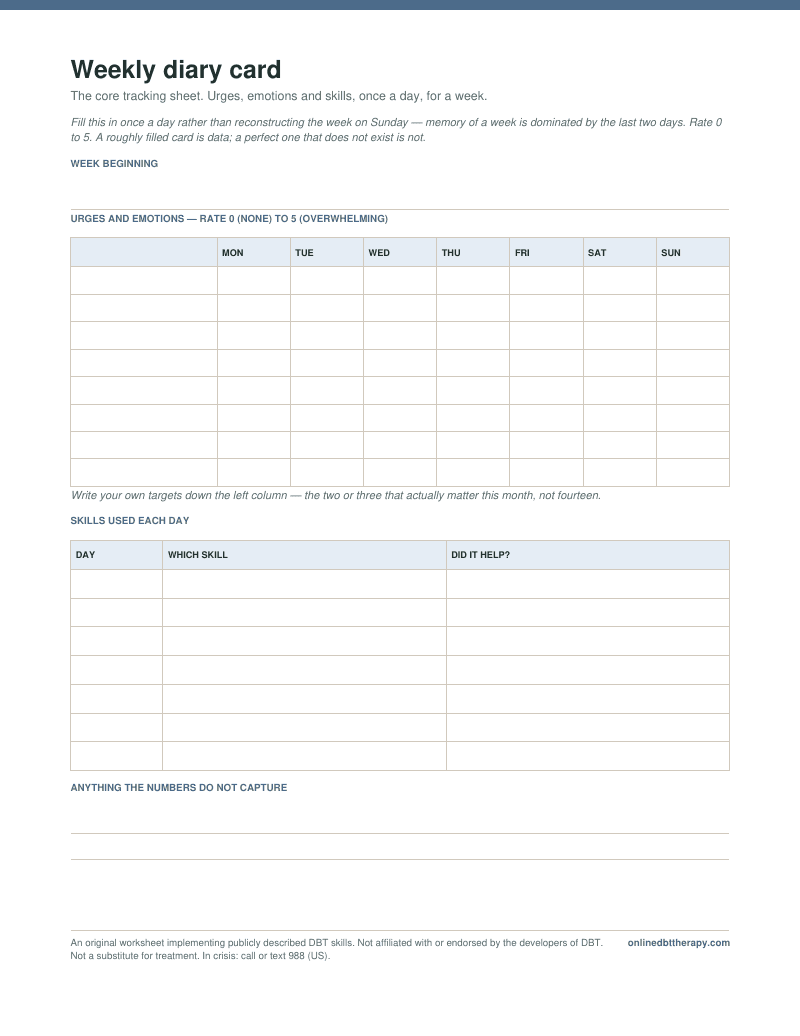
PDF, 1 page, 2.6 kB. US Letter, prints in black and white. No email required.
When to use it
Daily, at the same time — attached to something you already do, like brushing your teeth or plugging in your phone. Not reconstructed on Sunday.
How to fill it in
- Write your own targets down the left column of the first grid. Two or three that actually matter this month, not fourteen.
- Rate each one 0 to 5 every day. The scale only means anything relative to your own other entries, so consistency beats accuracy.
- In the second grid, note which skill you tried and whether it did anything. “Partly” is a real answer.
- Use the last lines for anything the numbers do not capture.
The thing that makes it useless
Leaving it blank because you missed four days. A card reconstructed from memory with two days guessed is data. A perfect one that does not exist is not.
The other worksheets
An original worksheet implementing skills that are widely taught and publicly described. It is not a reproduction of the published DBT handouts, which are copyrighted by their publisher, and nothing here is affiliated with or endorsed by the developers of DBT. If you are in a programme, use whatever your team gives you — a diary card your therapist designed is the one they will be reading.
General information, not clinical advice; the people described are composites, not real clients. DBT skills are not a substitute for treatment or for a safety plan. Listings on this site are maintained by independent practices. If you are in immediate danger, call 911; the 988 Suicide & Crisis Lifeline is available by call or text any time.