Coping ahead
A rehearsal of something difficult before it happens, including which skill you will use at which point.
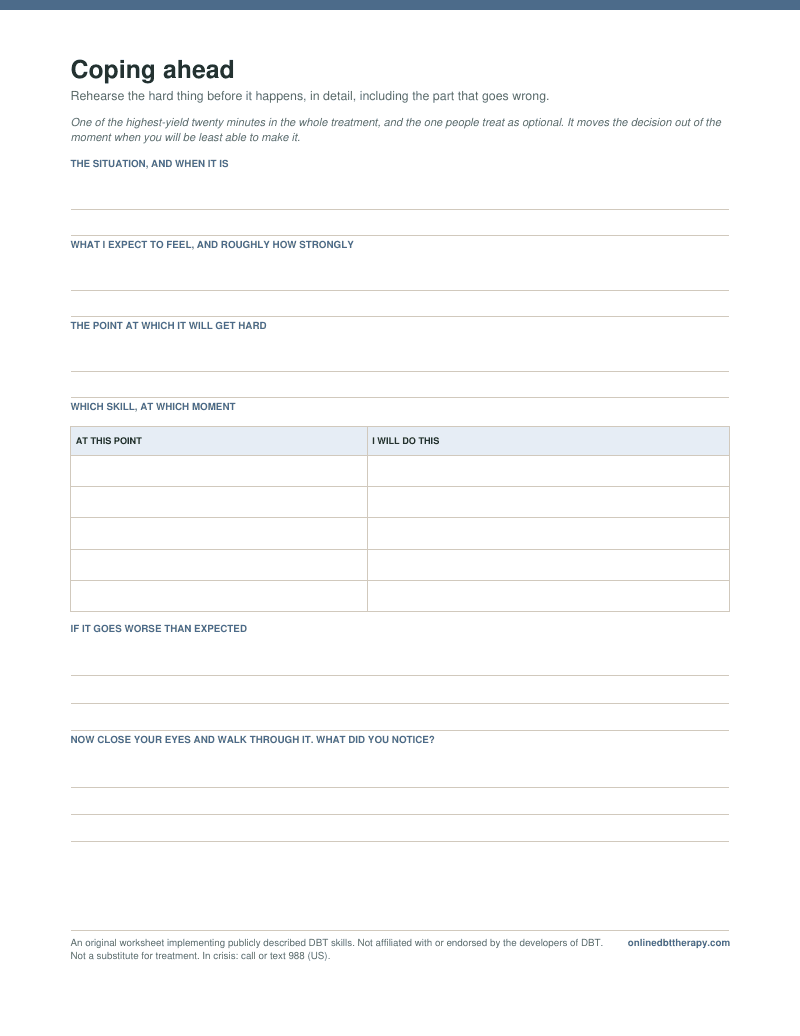
PDF, 1 page, 2.3 kB. US Letter, prints in black and white. No email required.
When to use it
A few days before a situation you already know is coming — the meeting, the visit, the anniversary.
How to fill it in
- Describe the situation and when it is.
- Write what you expect to feel and roughly how strongly, then identify the exact point at which it will get hard.
- Fill in the grid: at this point, I will do this. Name the skill rather than writing “use a skill”.
- Plan for it going worse than expected.
- Then close your eyes and actually walk through it. This step is the one people skip and it is the one that works.
The thing that makes it useless
Treating the imagining as optional. Writing the plan is preparation; rehearsing it is what moves the decision out of the moment when you will be least able to make it.
The other worksheets
An original worksheet implementing skills that are widely taught and publicly described. It is not a reproduction of the published DBT handouts, which are copyrighted by their publisher, and nothing here is affiliated with or endorsed by the developers of DBT. If you are in a programme, use whatever your team gives you — a diary card your therapist designed is the one they will be reading.
General information, not clinical advice; the people described are composites, not real clients. DBT skills are not a substitute for treatment or for a safety plan. Listings on this site are maintained by independent practices. If you are in immediate danger, call 911; the 988 Suicide & Crisis Lifeline is available by call or text any time.