Chain analysis
One incident taken apart link by link — the day, the trigger, every step to the behaviour, and everything after it.
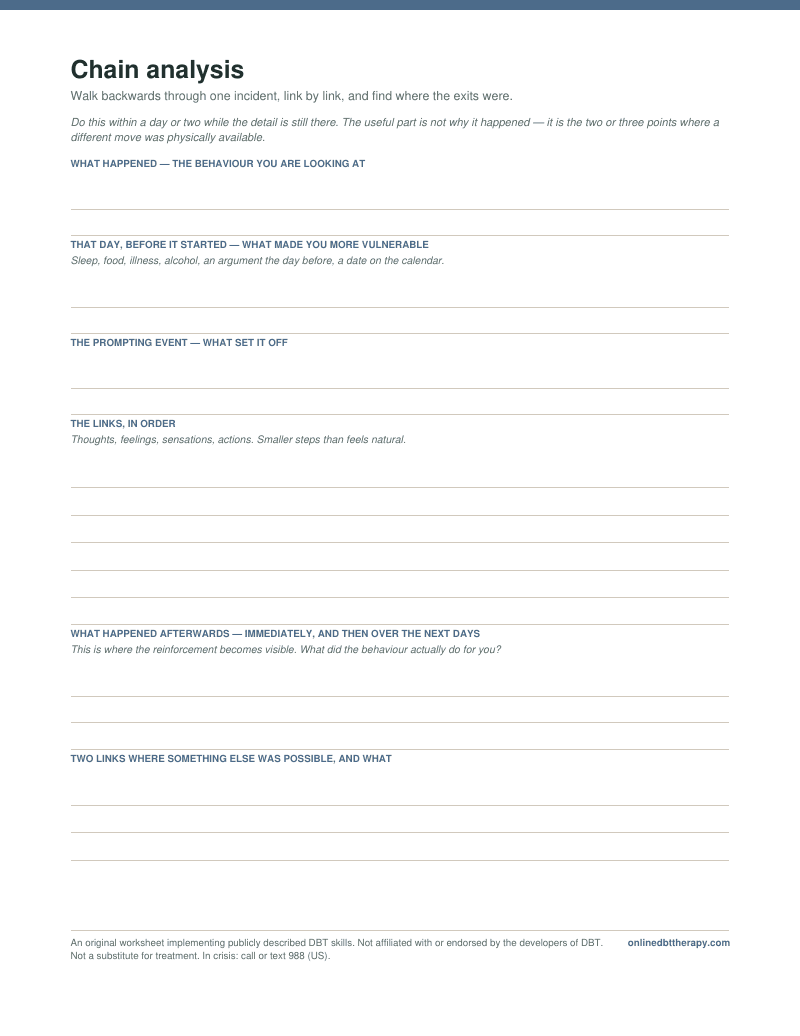
PDF, 1 page, 2.4 kB. US Letter, prints in black and white. No email required.
When to use it
Within a day or two of an incident, while the detail is still there. A chain reconstructed a week later is much thinner.
How to fill it in
- Name the behaviour plainly at the top. No judgment attached — this is a mechanical exercise.
- Fill in the vulnerability factors first: sleep, food, illness, alcohol, an argument the day before, a date on the calendar.
- Then the prompting event, then every link between it and the behaviour. Smaller steps than feels natural.
- Do the consequences half properly. What did the behaviour actually do for you, immediately and over the following days? You cannot replace it until you know.
- Finish by picking two links where something else was available, and write what.
The thing that makes it useless
Turning it into a moral audit. If yours consistently ends in a verdict about your character rather than a list of decision points, do them with your therapist for a while rather than alone.
The other worksheets
An original worksheet implementing skills that are widely taught and publicly described. It is not a reproduction of the published DBT handouts, which are copyrighted by their publisher, and nothing here is affiliated with or endorsed by the developers of DBT. If you are in a programme, use whatever your team gives you — a diary card your therapist designed is the one they will be reading.
General information, not clinical advice; the people described are composites, not real clients. DBT skills are not a substitute for treatment or for a safety plan. Listings on this site are maintained by independent practices. If you are in immediate danger, call 911; the 988 Suicide & Crisis Lifeline is available by call or text any time.