Check the facts
A structured way to separate what happened from what you are telling yourself about it — and to decide which one the emotion is responding to.
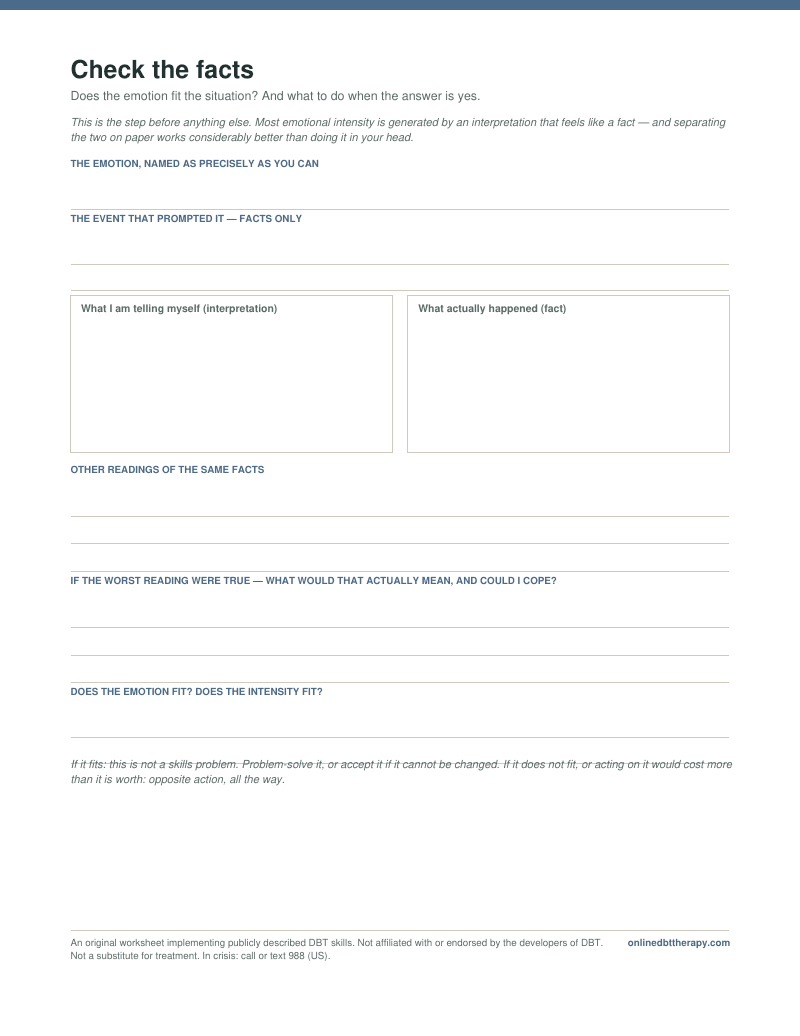
PDF, 1 page, 2.4 kB. US Letter, prints in black and white. No email required.
When to use it
When an emotion feels bigger than the event, and you are still below the point where thinking works.
How to fill it in
- Name the emotion as precisely as you can. “Ashamed, and underneath it frightened” is workable; “bad” is not.
- Write the prompting event in facts only.
- Use the two columns to split interpretation from fact. Most intensity is generated by the left column while feeling like it came from the right.
- List other readings of the same facts, then ask what the worst one would actually mean and whether you could cope.
- Answer both questions at the bottom: does the emotion fit, and does the intensity fit?
The thing that makes it useless
Using it above the line where thinking works. Past a certain arousal this just produces a more articulate version of the same conviction — drop the arousal first.
The other worksheets
An original worksheet implementing skills that are widely taught and publicly described. It is not a reproduction of the published DBT handouts, which are copyrighted by their publisher, and nothing here is affiliated with or endorsed by the developers of DBT. If you are in a programme, use whatever your team gives you — a diary card your therapist designed is the one they will be reading.
General information, not clinical advice; the people described are composites, not real clients. DBT skills are not a substitute for treatment or for a safety plan. Listings on this site are maintained by independent practices. If you are in immediate danger, call 911; the 988 Suicide & Crisis Lifeline is available by call or text any time.