Opposite action planner
A plan for doing the exact reverse of what an emotion is urging — completely, and more than once.
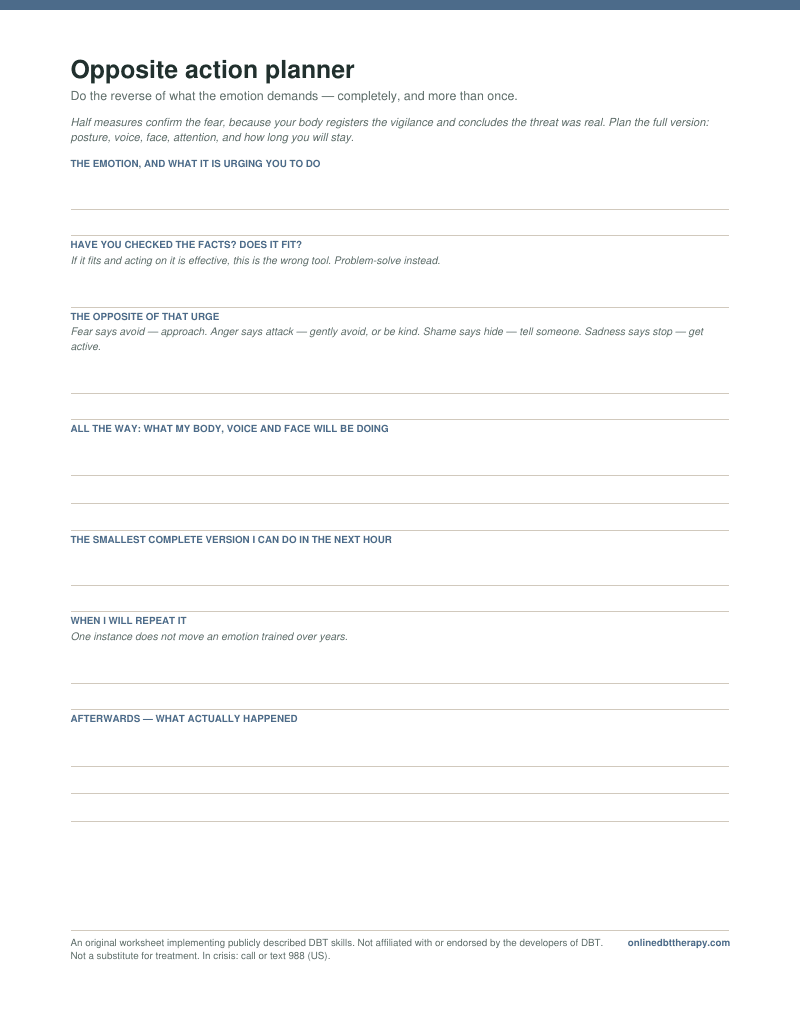
PDF, 1 page, 2.5 kB. US Letter, prints in black and white. No email required.
When to use it
After you have checked the facts and found the emotion does not fit, or that acting on it would cost more than it is worth.
How to fill it in
- Name the emotion and the urge it carries.
- Write the opposite. Fear says avoid, so approach. Anger says attack, so gently avoid or be kind. Shame says hide, so tell someone.
- Plan the all-the-way version: posture, voice, face, attention, and how long you will stay.
- Pick the smallest complete version you can do within the hour, and write down when you will repeat it.
- Come back afterwards and fill in what actually happened.
The thing that makes it useless
Half measures. Going out but standing near the door with your coat on teaches your nervous system that the vigilance was necessary — which confirms the fear rather than testing it.
The other worksheets
An original worksheet implementing skills that are widely taught and publicly described. It is not a reproduction of the published DBT handouts, which are copyrighted by their publisher, and nothing here is affiliated with or endorsed by the developers of DBT. If you are in a programme, use whatever your team gives you — a diary card your therapist designed is the one they will be reading.
General information, not clinical advice; the people described are composites, not real clients. DBT skills are not a substitute for treatment or for a safety plan. Listings on this site are maintained by independent practices. If you are in immediate danger, call 911; the 988 Suicide & Crisis Lifeline is available by call or text any time.