Pros and cons, four boxes
Four boxes rather than two: the pros and cons of acting on an urge, and the pros and cons of resisting it.
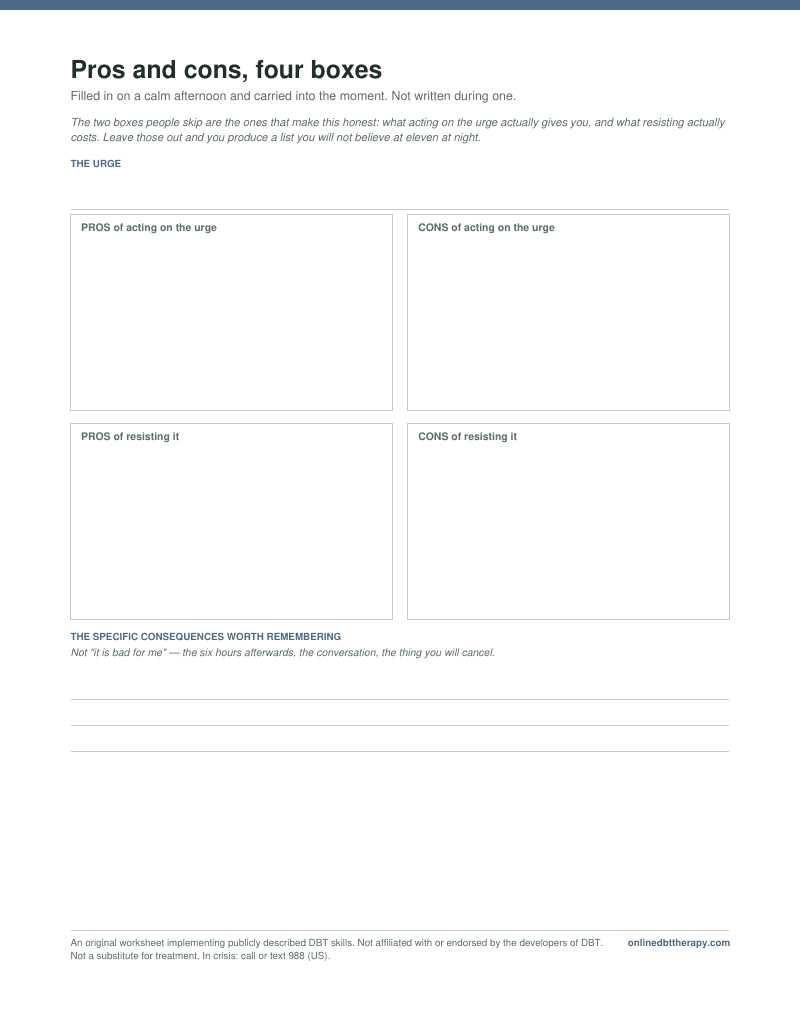
PDF, 1 page, 2.1 kB. US Letter, prints in black and white. No email required.
When to use it
On a calm afternoon, before you need it. Then carry the finished sheet — or a photograph of it — into the moment.
How to fill it in
- Name the urge specifically at the top.
- Fill in the pros of acting on it honestly. If there were no upside you would not be doing it, and pretending otherwise is what made every previous list useless.
- Do the cons of resisting too. It is harder, it hurts more now, and you may have to feel something you have avoided for years.
- Be specific in the consequence boxes — the six hours afterwards, the conversation, the thing you will cancel.
- When the urge comes, read it. Do not re-argue it; you already had that argument with a clearer head.
The thing that makes it useless
Filling it in during a crisis. At the peak of an urge you will produce a beautifully reasoned list that arrives at the answer you already wanted.
The other worksheets
An original worksheet implementing skills that are widely taught and publicly described. It is not a reproduction of the published DBT handouts, which are copyrighted by their publisher, and nothing here is affiliated with or endorsed by the developers of DBT. If you are in a programme, use whatever your team gives you — a diary card your therapist designed is the one they will be reading.
General information, not clinical advice; the people described are composites, not real clients. DBT skills are not a substitute for treatment or for a safety plan. Listings on this site are maintained by independent practices. If you are in immediate danger, call 911; the 988 Suicide & Crisis Lifeline is available by call or text any time.